
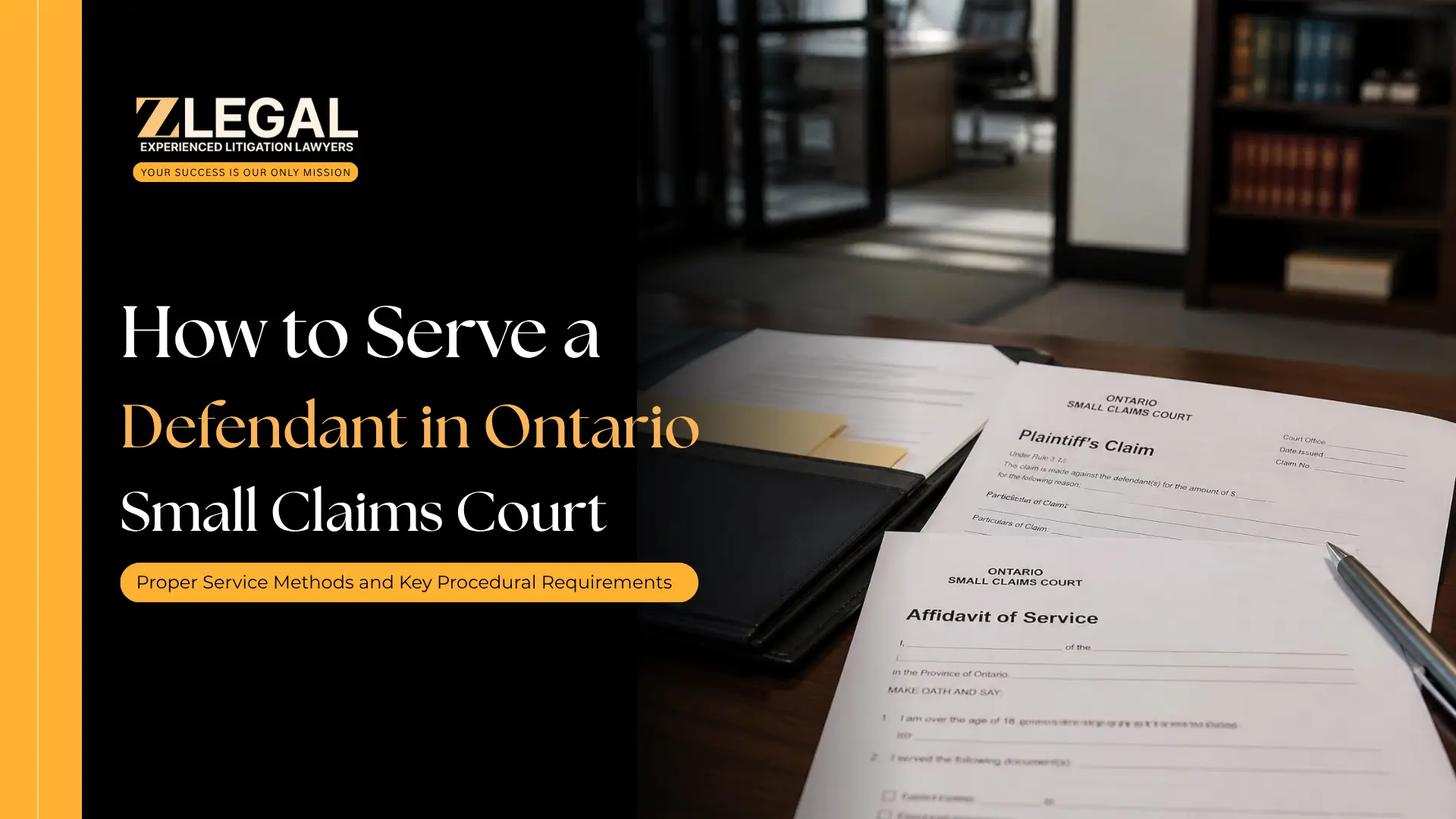
Filing a plaintiff’s claim represents only the first step in starting a lawsuit. Specifically, a lawsuit cannot proceed until you serve a defendant in Ontario Small Claims Court using approved legal methods. Consequently, proper service brings the defendant under court jurisdiction and starts their mandatory 20-day deadline to file a defence. Furthermore, technical errors in serving documents can delay your proceedings or invalidate a default judgment. Therefore, partnering with a skilled Toronto litigation lawyer ensures your legal team completes every procedural step correctly from the beginning.
Essential Rules to Serve a Defendant in Ontario Small Claims Court
Rule 8 of the Rules of the Small Claims Court governs how parties deliver legal documents. First, Rule 8.01 requires plaintiffs to serve each defendant within six months of court issuance. Second, the person bringing the lawsuit cannot personally hand documents to the opposing party. Instead, a non-party adult or a professional process server must deliver the materials to maintain credible proof.
Additionally, personal service remains the standard method for individuals and corporate entities. Specifically, for individuals, personal service requires handing documents directly to the named defendant. Meanwhile, for corporations, servers deliver documents to an officer, director, or manager appearing in control. Furthermore, if you need to determine the correct court venue before filing, you can review our guide on Small Claims Court vs Superior Court Ontario.
Step-by-Step Guide to Serve a Defendant in Ontario Small Claims Court
Executing service correctly requires strict adherence to statutory protocol. Specifically, litigants should follow these six structured steps:
-
Confirm the exact legal name of individual or corporate defendants before service.
-
Select an appropriate service method, prioritizing direct personal delivery whenever possible.
-
Engage a neutral adult or process server to deliver the physical court papers.
-
Execute service promptly well inside the initial six-month validity window.
-
Complete and swear an affidavit of service detailing exact delivery particulars immediately.
-
File proof of service with the court and monitor the 20-day response clock.
However, failing to file an accurate affidavit of service prevents you from taking further court steps. For instance, if you face strict civil timelines, our comprehensive article on Ontario civil lawsuit deadlines explains procedural response rules.
Locating Missing Defendants and Seeking Substituted Service
Defendants sometimes attempt to evade service or relocate without leaving a forwarding address. However, a missing defendant does not automatically end your legal action. First, you must conduct diligent skip-tracing efforts, checking public registries, phone directories, and past employers.
Additionally, you must maintain a detailed written log documenting every search attempt and result. Second, if diligent search efforts fail, you can file a motion for substituted service. Consequently, a judge can authorize alternative delivery methods, such as email delivery or registered mail. Furthermore, for general information about our firm, you can visit Z Legal to explore civil litigation options. In addition, you can consult the official Ontario Courts Administration portal for provincial court forms and rules.
Procedural Next Steps After Completing Service
Once service occurs, the defendant’s 20-day response clock begins immediately. Specifically, if the defendant files a defence within 20 days, the court schedules a mandatory settlement conference. Conversely, if the defendant fails to respond, you can note them in default.
Subsequently, noting a defendant in default allows you to obtain a default judgment for your claim amount. Therefore, establishing proper service forms the necessary foundation for all enforcement actions. Ultimately, avoiding common mistakes like self-service or missing deadlines protects your legal rights throughout litigation.
Frequently Asked Questions
Can I serve the plaintiff’s claim on the defendant myself?
No. Specifically, parties to a lawsuit cannot serve their own court documents. Instead, a neutral adult or process server must deliver the claim.
How long do I have to serve a defendant in Ontario Small Claims Court?
You have exactly six months from the date the court issues the claim to complete service.
What is an affidavit of service?
An affidavit of service is a sworn legal document proving when, where, and how a server delivered court papers.
What happens if a defendant avoids personal service?
You can apply to the court for an order permitting substituted service by alternative methods like email or mail.
What is the deadline for a defendant to file a defence?
A defendant must file a statement of defence within 20 days after receiving proper service.
Can I serve a corporation by mail in Ontario?
Yes. Indeed, the rules permit service on corporations by registered mail or courier under specific conditions.
This article is general information, not legal advice. For advice on your specific matter, please contact Z Legal.